

Last updated:
Short answer: to stop mice, use an aperture of 6 mm or less. Against rats and voles, 10–13 mm is commonly used, but smaller is safer if mice may also be a problem. Use wire of about 1 mm or thicker so the mesh cannot be gnawed through, and stainless steel so it does not rust away in the soil. getwiremesh cuts every sheet to the size you order.
What aperture keeps which animals out?
A house mouse can squeeze through a gap of about 6 mm, and a young rat through about 12 mm. Mesh for rodents should therefore be chosen by the smallest animal you need to stop:
| Aperture | Stops | Typical use |
|---|---|---|
| 4–6 mm | mice, rats, voles | air bricks, vents, sheds, compost bins |
| 8–10 mm | rats, voles, moles | raised beds, under decking |
| 11–13 mm | voles, moles | raised beds where mice are not an issue |
In Britain the usual targets are the house mouse, the brown rat and the field vole in gardens. The water vole is a protected species: check with Natural England, Natural Resources Wales or NatureScot before blocking burrows near water.
How thick should the wire be?
Use wire of about 1 mm or thicker. Rodents gnaw, and fine mesh with thin wire can be chewed through by a determined rat. All meshes in the table below have wire of 1 mm or more.
| Mesh | Aperture | Wire | Open area | Weight | Price |
|---|---|---|---|---|---|
| V2A 4 × 1 mm | 4 mm | 1 mm | 64 % | 2.4 kg/m² | £41.00/m² |
| V2A 5 × 1 mm | 5 mm | 1 mm | 69 % | 2 kg/m² | £35.00/m² |
| SG 6 × 1 mm | 6 mm | 1 mm | 73 % | 1 kg/m² | £79.00/m² |
| V2A 8 × 1 mm | 8 mm | 1 mm | 79 % | 1.56 kg/m² | £43.00/m² |
| V2A 10 × 1.4 mm | 10 mm | 1.4 mm | 77 % | 3 kg/m² | £50.00/m² |
| SG 10 × 1 mm | 10 mm | 1 mm | 83 % | 1 kg/m² | £49.00/m² |
Woven or welded mesh?
Both work; they handle differently. Welded mesh is rigid, stays flat and its cut edges do not unravel, which makes it easy to lay in raised beds. Woven mesh is more flexible, so it is easier to bend around corners, into vents and up the walls of a bed.
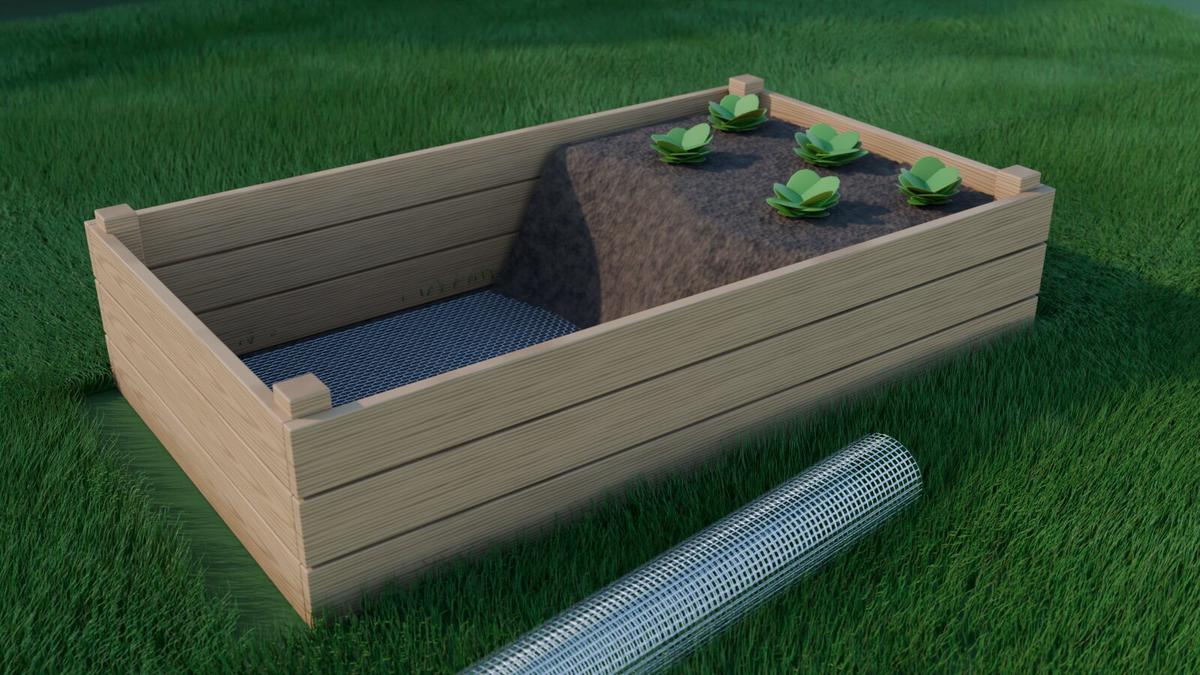
How do you protect a raised bed from voles?
Line the whole base before filling:
- Cut the mesh to the inner footprint of the bed plus about 10 cm on every side.
- Lay it flat on the levelled ground, without gaps.
- Bend the extra 10 cm up the inner walls and fix it with stainless staples or screws.
- Where two sheets meet, overlap them by several mesh openings.
- Fill with soil. Roots grow through the mesh; animals cannot.
Ordering a sheet cut to the exact size saves joins. We cut every sheet to your width and length.
How do you rodent-proof air bricks and vents?
Cover the opening with mesh of 6 mm or less and fix it with stainless screws on all sides. Check that the mesh sits tight against the wall, because mice use gaps at the edge rather than the mesh itself. The same method protects shed vents, compost bins and the gaps under decking.
What rodent mesh is not suited for
- Closing large holes in walls. Fill those with mortar or a steel plate first; mesh only covers openings that must stay open.
- Fine filter mesh as rodent protection. Thin wire under about 0.5 mm can be chewed through.
- Replacing pest control. Mesh keeps animals out; it does not remove animals that are already inside.
Frequently asked questions
What size mesh keeps mice out?
Use 6 mm or less. A house mouse can pass through a gap of about 6 mm, so a 4–6 mm aperture with 1 mm wire is the safe choice for air bricks, vents and sheds.
Will plant roots grow through stainless steel mesh?
Yes. Roots pass through the openings of a 10–13 mm mesh without difficulty, while voles and moles cannot. Line the base of the bed before filling it.
Should I use woven or welded mesh under a raised bed?
Welded mesh is easier: it stays flat, does not unravel at the cut edge and is simple to bend up the sides. Woven mesh is more flexible where the shape is irregular.
Does stainless steel mesh rust in soil?
V2A (AISI 304) mesh is sufficient in normal garden soil and lasts for decades. Use V4A (AISI 316) where the soil or water is salty, for example in coastal gardens.
Browse the V2A woven mesh and the welded mesh ranges. For insects rather than rodents, see the insect screen guide.
Sources and further reading
- Wikipedia: voles and house mouse
- GOV.UK: pest control — who is responsible