
Last updated:
Short answer: the aperture decides the particle size that is held back: a 0.1 mm aperture, which equals 100 µm, retains particles larger than about 100 µm. The open area decides how fast liquid or air flows through. Pick the largest aperture that still holds back what you need to catch, use V4A for salt water and aggressive media, and back very fine mesh with a coarser support mesh.
How does the aperture relate to particle size?
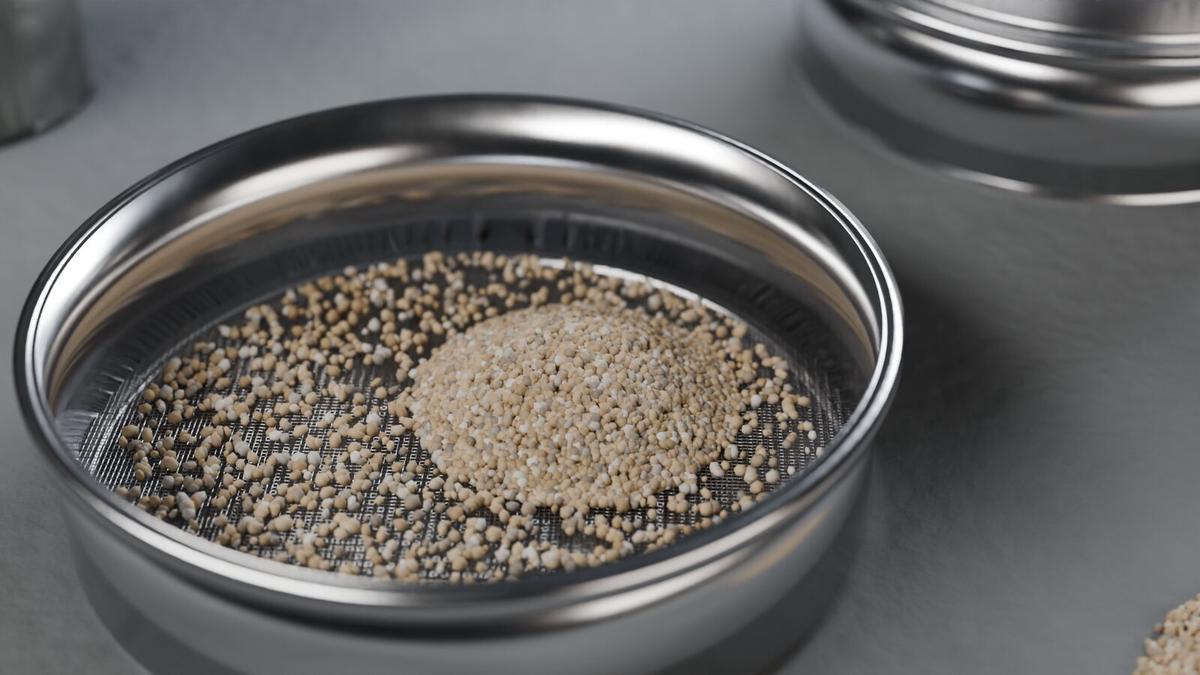
The aperture is the clear opening between two wires. To convert it to microns, multiply the millimetres by 1000. Particles larger than the aperture are retained; smaller ones pass. Elongated or soft particles can pass openings smaller than their length, so the aperture is a nominal guide, not an absolute cut-off.
| Task | Typical aperture |
|---|---|
| Coarse straining, leaf and debris traps | 1–2 mm |
| Sand, soil and grit sieving | 0.4–1 mm |
| Fine straining of liquids | 0.15–0.25 mm (150–250 µm) |
| Very fine filtration | 0.075–0.1 mm (75–100 µm) |
Why does open area matter?
Open area is the share of the surface that is holes. A higher open area means more flow and less pressure drop at the same aperture. Fine meshes need thin wire to keep a useful open area, which also makes them more delicate. The table below calculates the open area from aperture and wire diameter.
| Mesh | Aperture | Wire | Open area | Weight | Price |
|---|---|---|---|---|---|
| V4A 0.075 × 0.05 mm | 0.075 mm (75 µm) | 0.05 mm | 36 % | 0.2 kg/m² | 38 €/m² |
| V2A 0.1 × 0.065 mm | 0.1 mm (100 µm) | 0.065 mm | 37 % | 0.33 kg/m² | 42 €/m² |
| V2A 0.15 × 0.1 mm | 0.15 mm (150 µm) | 0.1 mm | 36 % | 0.4 kg/m² | 34 €/m² |
| V2A 0.25 × 0.16 mm | 0.25 mm (250 µm) | 0.16 mm | 37 % | 0.8 kg/m² | 30 €/m² |
| V2A 0.4 × 0.25 mm | 0.4 mm (400 µm) | 0.25 mm | 38 % | 1.22 kg/m² | 44 €/m² |
| V2A 0.5 × 0.2 mm | 0.5 mm (500 µm) | 0.2 mm | 51 % | 0.73 kg/m² | 32 €/m² |
| V2A 1 × 0.3 mm | 1 mm | 0.3 mm | 59 % | 0.88 kg/m² | 32 €/m² |
| V2A 2 × 0.5 mm | 2 mm | 0.5 mm | 64 % | 1.2 kg/m² | 38 €/m² |
V2A or V4A for filters?
V2A suits fresh water, food, oils and most neutral media. Choose V4A for salt water, brine, chlorinated water and many process chemicals, because molybdenum gives it much better resistance to chloride pitting. Several fine meshes are available in both grades; see V2A vs V4A.
Tips for fine filter mesh
- Support it. Very fine mesh deforms under pressure. Lay a coarse mesh behind it as a support layer.
- Clamp, don't glue. Clamping the edge in a frame or flange keeps the mesh tight and replaceable.
- Clean from the clean side. Back-flushing removes trapped particles without forcing them deeper into the openings.
What woven wire mesh is not suited for
- Anything finer than 75 µm. Our finest mesh has a 75 µm aperture. Fine dust, bacteria and sub-micron particles need membrane or depth filters.
- Certified particle-size analysis. Laboratory test sieves are made and certified to ISO 3310-1. Mesh sold by the metre is not a certified test sieve.
- Sterile or medical filtration. These need validated filter media.
All meshes are cut to the size you order. See the full V2A and V4A ranges.